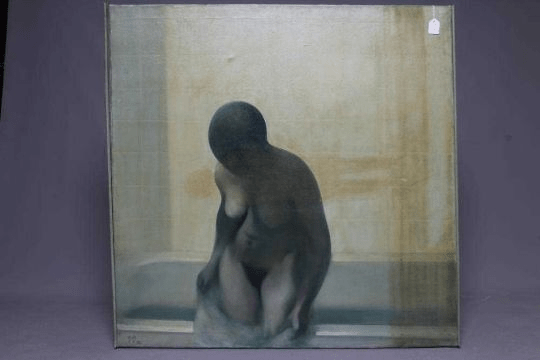
I’ve recently bought a painting. I’m not rich enough to be a serious collector, but this was a bit special. Let me explain. When I worked at Wakefield College in the eighties, I took a flat in Heath Hall, a Georgian stately home in a village just outside Wakefield. I’ll tell you how stately: my lease required access twice a year to the monumental clock that dominated the hall’s stable yard. Just over the village green was The Old Smithy and Joiner’s Shop, a renovated cottage which was the home of Gyorgy and Marian Gordon, two Hungarians who came to the UK after the 1956 uprising. Gyorgy was an artist, and after working for a while in commercial graphic design, he was offered a job lecturing at the college in fine art. He worked with many distinguished students, but after some years made the decision to retire to work full-time as a painter. His work is in several major galleries, here and in Hungary. The portrait of the Lindsey String Quartet in the National Portrait Gallery is his, and the Hepworth Gallery as well as the NPG has hosted an exhibition of his work.
Gyorgy died in 2005, and the Lindseys played Bartok – what else ? – at his funeral. There are several good obituaries. The Independent one reads well, as does the Wakefield Art Gallery. They describe an extraordinary life, one that reminds those of my generation, born in Britain at the end of the Second World War, what a charmed time we have led. Gyorgy grew up in wartime Hungary, was conscripted as a teenager to serve the German economy as a forestry labourer. When the word came that they were going to be drafted into the army to fight the Russians, he escaped to the chaos of occupied Budapest. He told me once of seeing the tanks of the Red Army enter the city whilst hiding in the damaged flat of family friends. That period affected his art – the torso of a horse killed for meat in a frozen street shown in one of his more harrowing works. After the war, he studied in an increasingly Communist country, until the events of 1956 led him to flee to the west, over the passes to Austria, hand-in-hand with his daughter. His first wife, a dedicated Communist, stayed.
Despite these events, he was a lovely man, cultured, kind, witty. My children remember him with affection. I spent some memorable evenings at the Heath house, once playing bridge in Hungarian with a visitor from the homeland. When the Berlin Wall fell, the Hungarian government could acknowledge the quality of his work, and I was able to visit an exhibition in Budapest itself. I liked the style of his work – very central European, with a bleak expressionism, apparently at odds with his charm and generosity.
For all of these reasons, I’d long wanted to own one of his paintings, and there are sites on the web that alert you when particular artist’s work comes up for auction. To cut a long story short, I saw that one was going to be sold in an auction at Ilkley, made a bid by e-mail, and won for the ludicrous sum of £500. VAT, framing and auction costs doubled that, of course, but … no regrets.

 Grumpy Wisdom
Hi, I am Georges daughter Anna ,did enjoy your blog, mostly correct, but I did mostly walk.
That painting was a steal, great lucky find.
LikeLike