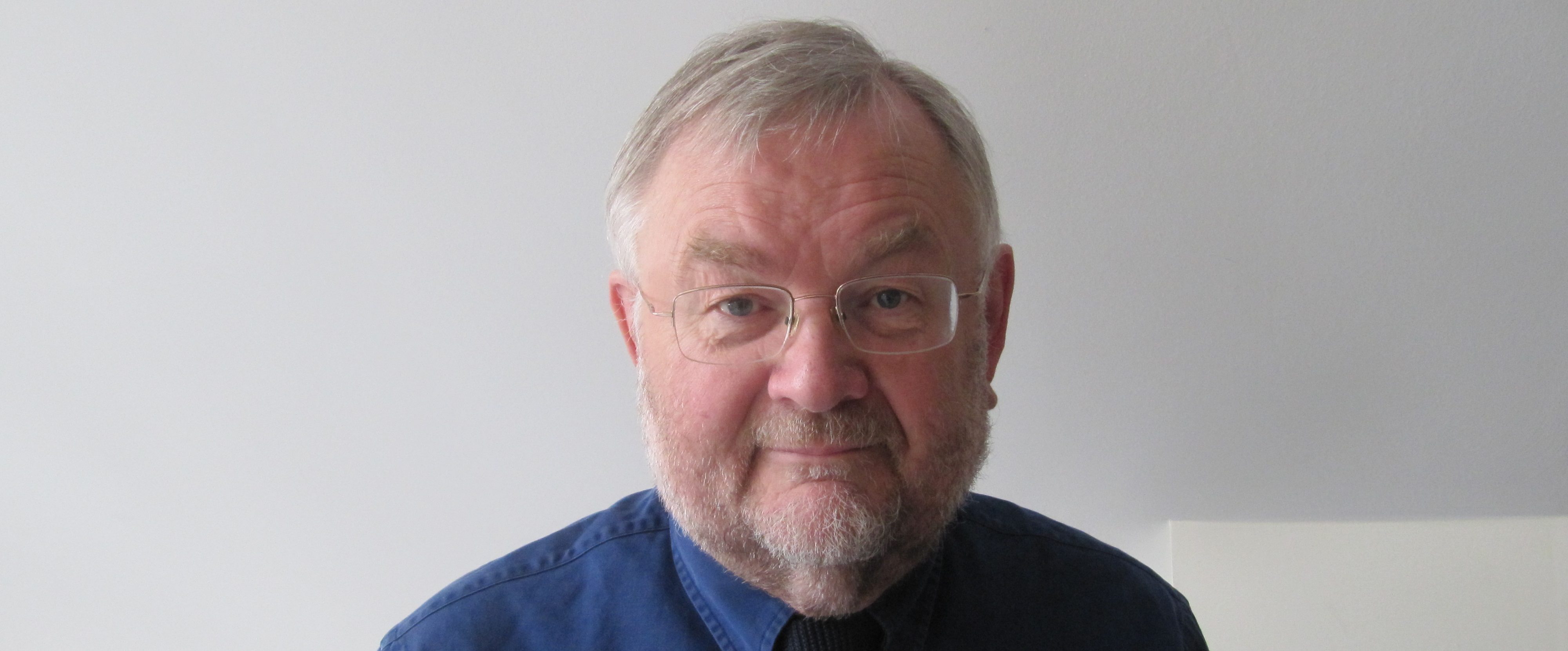
Gyorgy Gordon

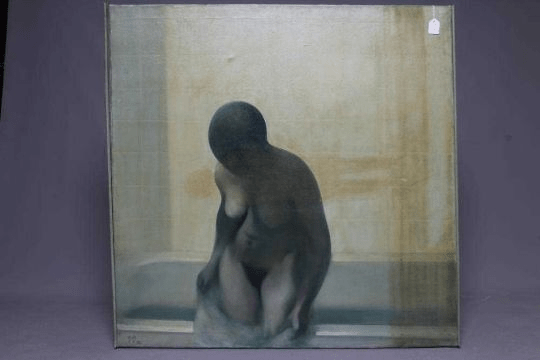
I’ve recently bought a painting. I’m not rich enough to be a serious collector, but this was a bit special. Let me explain. When I worked at Wakefield College in the eighties, I took a flat in Heath Hall, a Georgian stately home in a village just outside Wakefield. I’ll tell you how stately: my lease required access twice a year to the monumental clock that dominated the hall’s stable yard. Just over the village green was The Old Smithy and Joiner’s Shop, a renovated cottage which was the home of Gyorgy and Marian Gordon, two Hungarians who came to the UK after the 1956 uprising. Gyorgy was an artist, and after working for a while in commercial graphic design, he was offered a job lecturing at the college in fine art. He worked with many distinguished students, but after some years made the decision to retire to work full-time as a painter. His work is in several major galleries, here and in Hungary. The portrait of the Lindsey String Quartet in the National Portrait Gallery is his, and the Hepworth Gallery as well as the NPG has hosted an exhibition of his work.

Gyorgy died in 2005, and the Lindseys played Bartok – what else ? – at his funeral. There are several good obituaries. The Independent one reads well, as does the Wakefield Art Gallery. They describe an extraordinary life, one that reminds those of my generation, born in Britain at the end of the Second World War, what a charmed time we have led. Gyorgy grew up in wartime Hungary, was conscripted as a teenager to serve the German economy as a forestry labourer. When the word came that they were going to be drafted into the army to fight the Russians, he escaped to the chaos of occupied Budapest. He told me once of seeing the tanks of the Red Army enter the city whilst hiding in the damaged flat of family friends. That period affected his art – the torso of a horse killed for meat in a frozen street shown in one of his more harrowing works. After the war, he studied in an increasingly Communist country, until the events of 1956 led him to flee to the west, over the passes to Austria, hand-in-hand with his daughter. His first wife, a dedicated Communist, stayed.

Despite these events, he was a lovely man, cultured, kind, witty. My children remember him with affection. I spent some memorable evenings at the Heath house, once playing bridge in Hungarian with a visitor from the homeland. When the Berlin Wall fell, the Hungarian government could acknowledge the quality of his work, and I was able to visit an exhibition in Budapest itself. I liked the style of his work – very central European, with a bleak expressionism, apparently at odds with his charm and generosity.

For all of these reasons, I’d long wanted to own one of his paintings, and there are sites on the web that alert you when particular artist’s work comes up for auction. To cut a long story short, I saw that one was going to be sold in an auction at Ilkley, made a bid by e-mail, and won for the ludicrous sum of £500. VAT, framing and auction costs doubled that, of course, but … no regrets.
“YouTube, if you want to …”

There are some wonderful clips and films on YouTube.  You can sit at breakfast, or on your exercise bike, and look at lectures on the War of Austrian Succession, explanations of the workings of a two-stroke engine and concerts by wonderful musicians, classic or popular, that you’ve heard of or not.  You can also find fascinating but weird memes.  One guy films himself cleaning out and reshoeing the feet of cows and horses, and it’s fascinating.  There’s an American doctor squeezing and cutting out pimples and cysts from a variety of patients/victims. Even effective and victorious England cricket teams.

But there’s one group in which genuine historical information and access to wonderful cinema clips from the 1920s and 30s are broadcast: not drama, just newsreels from world cities or publicity flicks from transport companies or public corporations,  Victorians cross London’s bridges, with their universal hat-wear.  Horse-drawn buses swing and sway along recognisable urban thoroughfares.  Spotless suburbs attract the 1940s home buyer away from the congested inner city. I used to like these, but sadly, the infection from Twitter has spread across to YouTube, and the comments appended to these clips are usually right-wing dross – racism dressed up as nostalgia for a purer, better age.  Perhaps I’m getting paranoid, but I think the sub-text to the various versions of “London looks like a wonderful city – I wonder what became of it” can be filed among the nasty stuff attacking the current mayor (who has an Asian background) as presiding over a unmanageable and murderous cityscape, and the (wildly incorrect, funny if it wasn’t so nasty) American right wing idea that British cities are crime-ridden hell-holes.

I used to do sombre corrections, pointing out that the crime rates in UK cities are way below those in the USA.  As someone who lived in London in the 1950s, I’m immune to much nostalgic nonsense. I walked to school in the smog. I met young people limping after polio, their braces clanking. I remember a time before the “health and safety nonsense”, when 30 people were killed at the 1952 Farnborough Air Show and 90 more from the 1957 Lewisham rail crash. You only have to look at black-and-white working class dramas of the period on TV – on Talking Pictures TV, for example – to see its drudgery and poverty. I’ve realised, though, that aggressive counter-punching contributes to the pollution of the channel, and have chosen wide-eyed and innocent helpfulness instead.  I append below my response to the latest “what happened to London ?” comment,

“Good news, I’m glad to say.  Life expectancy rose considerably. Household income more than trebled. Central heating, Multichannel TV. Washing machines, Greatly increased car ownership, with falling road deaths. Crime rates fell. Foreign holidays. Internet. Effective and accessible contraception. A new National Theatre and buzzy South Bank. Free, magnificently modernised museums. Smog, which killed 12,000 in 1952, eliminated by Clean Air Acts.  Much better food, from all over the world.  3 new tube lines, plus the DLR to support regenerated Docklands. Blackwall Tunnel doubled in capacity, plus the M25 and Dartford Crossing.  An end to compulsory military service, and colonial wars. University entry rises from 4% to 45%. Free health care. London’s schools radically improved.  Filthy public buildings cleaned, to face new and innovative towers – the Shard, the Gherkin and many others.  Painless dental care.  Drinkable beer and edible bread. 29 Olympic Gold medals at London 2012, against 3 in the 1948 London Olympics.  Gay people live without fear, and backstreet abortions have gone. I could go on …”

I have currently had no reply.  Of course I haven’t.